
Expenditures in the Transportation Sector
The transportation sector consists of private and public vehicles that move people and commodities. Included are automobiles, trucks, buses, motorcycles, railroads, aircraft, ships, barges, and natural gas pipelines. Natural gas use reflects the fuel needed to move natural gas through a pipeline to end users in the residential, commercial, industrial, and electric power sectors. Since 1990, natural gas consumption also includes natural gas consumed as vehicle fuel.
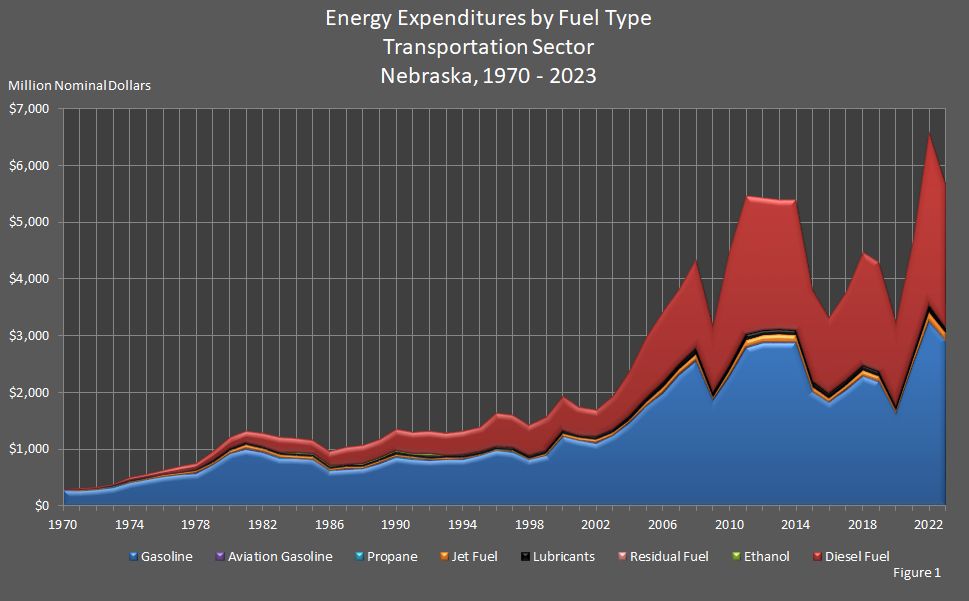
Total transportation sector expenditures on energy decreased 14 percent to $5,663.9 million ($5.7 billion) from 2022 to 2023. In 2023, the transportation sector spent $2,901.7 million ($2.9 billion) for motor gasoline, $2,519.5 million ($2.5 billion) for diesel fuel, $92.2 million for lubricants, $132.5 million for jet fuel, $1.0 million for propane, $10.8 million for natural gas, and $5.6 million for aviation gasoline. In 2023, if there were any expenditures on coal, electricity, or residual fuel in the transportation sector, the amounts were so small that the numbers rounded to zero in this table. The expenditures on ethanol were not tracked.
Motor gasoline (51 percent) and diesel fuel (44 percent) expenditures comprised almost all of the money spent in the transportation sector on energy in 2023. Expenditures on jet fuel were 2.3 percent and lubricants were 1.6 percent of the total while each of the other fuels' expenditures was less than one percent.
The expenditures are in nominal dollars to provide a better comparison.
| Attachment | Size |
|---|---|
| 2010 - 2023 | 45.02 KB |
| 1970 - 2009 | 47.5 KB |
Sources: State Energy Price and Expenditure Report. Energy Information Administration, Washington, DC. Nebraska Department of Water, Energy, and Environment, Lincoln, NE.
This report was updated on February 11, 2026.
Typically, there is a year between updates.