DHHS/DWEE Issues Smoke Advisory for Southeastern Nebraska
Issued jointly from
Department of Water, Energy, and Environment
Nebraska Department of Health and Human Services
News Release
DHHS/DWEE Issues Smoke Advisory for Southeastern Nebraska
Lincoln, NE – Smoke associated with prescribed burning in the Flint Hills region may affect air quality in Nebraska.
Issued for: 8:00 p.m. Saturday, March 21, 2026, through 9:00 a.m. Sunday, March 22, 2026
Affected Area: Southeastern Nebraska
Air Quality Index: Moderate to periodic Unhealthy for Sensitive Groups
Potential Air Quality Impacts from Prescribed Burning
An advisory of possible Moderate to periodic Unhealthy for Sensitive Groups Air Quality Index (AQI) impacts may occur in southeastern Nebraska, potentially affecting Lincoln, Omaha, Beatrice, Bellevue, Fairbury, and Nebraska City during the evening of Saturday, March 21, 2026, through the morning of Sunday, March 22, 2026. The following counties are subject to this advisory: Butler, Cass, Dodge, Douglas, Gage, Jefferson, Johnson, Lancaster, Nemaha, Otoe, Pawnee, Richardson, Saline, Sarpy, Saunders, Seward, and Washington.
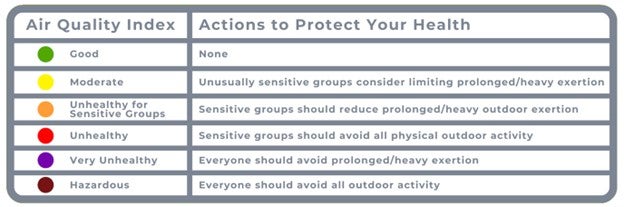
During Moderate (AQI yellow category) conditions, those who are unusually sensitive to particle pollution may experience health effects and are advised to minimize prolonged or heavy exertion. Symptoms such as coughing or shortness of breath are signs to take it easier.
During Unhealthy for Sensitive Groups (orange category) conditions, members of sensitive groups may experience health effects. Sensitive groups include people with heart or lung disease, older adults, children/teens, pregnant women, and those who are active outdoors. Members of sensitive groups are advised to minimize prolonged or heavy exertion outdoors and take more breaks.
Advisories are issued for areas of anticipated impact by notifying the media and local health departments and posting information on the Nebraska Department of Health and Human Services (DHHS) and the Nebraska Department of Water, Energy, and Environment's (DWEE) webpages and social media accounts. These advisories provide information to the public on the anticipated impacts on air quality and resources to help citizens protect their health and minimize exposure to smoke.
States monitor smoke levels and weather conditions to determine when impacts to air quality are anticipated. Advisories are based on data from the National Weather Service (NWS), the states of Kansas and/or Oklahoma, smoke plume modeling, and ambient air quality monitors located in Omaha, Blair, Bellevue, Lincoln, Beatrice, Grand Island, and Scottsbluff.
The following Air Quality Index (AQI) is used to describe air quality and suggest actions individuals can take to protect their health. This AQI is used nationwide and is available in real time for Nebraska at the AirNow website.
For more information on smoke awareness, visit DWEE's Smoke Awareness webpage.
For more information on burn activity and a smoke outlook, visit the Kansas Flint Hills Smoke Management website.
View The Kansas Department of Health and Environment’s seasonal news releases for information on the Flint Hills burns.
For AQI readings at individual ambient air monitors and sensors, please visit the AirNow Fire and Smoke Map.